
Uncovering the origin of our produce used on Quetzaltrekkers hikes
By: William Heaton
A staple and often a ‘rose’ on many a Quetzaltrekkers hike is the fresh produce. We spend hours each day prior to trek cutting, packaging, and preparing our food – making us wonder where exactly it comes from and just how fresh it is. Coming from a small agricultural community myself and having worked on a crew of migrant agricultural laborers from Latin America in California, this topic has always been a special interest of mine. Thus, I decided to investigate for myself where exactly this food comes from, the process by which it arrives to us, and hopefully track the produce we use all the way back to the farms on which it is grown. Learning something more about the agricultural system of Guatemala as a whole as well as the people and stories that it touches.
I started at the famous Mercado de Flores in Zona 1 of Quetzaltenango to speak directly with the people who sell us our produce. Quetzaltrekkers has been frequenting this market and buying produce there since the organization’s inception 30 years ago. Over that time we have developed relationships with many of the vendors, including that of the Lopez family. Since my first time at the market over a year ago, I have grown close with Paula of said stand, and subsequently the other members of this family, having learned quite a bit about not only their story, but of the produce they sell. Started 70 years ago, the Mercado de Flores is a relatively new market space in Xela, with the previous and well established locations being that of the Democracia, Centro Commercial, and La Terminal. According to the patriarch of the Lopez family, Don Juan Lopez, this market started when the people of Zone 1 recognized the need for a produce market in this part of town. The Lopez family started selling at the market 40 years ago with the grandmother of Paula, who began by selling produce on a blanket, slowly growing over the years, with the family now commanding a central stand in the market. The Lopez family has created a four generation family business with every member of the family contributing to its success.
A well established and smooth system, one member of the family works the stand, selling the fresh produce to eager customers while the other members of the family are out at local markets buying in bulk, replenishing the daily stock of produce. The stand carries staples such as carrots, onions, cauliflower, broccoli, lettuce, avocados, celery, cabbage, peppers, cucumbers, potatoes and so many more – a variety of produce that has not changed in almost 40 years. Don Lopez tells me the idea of the stand is to continually sell the freshest possible produce directly to the consumer with the inventory being changed almost daily. The reason for this system is simple, according to Don Lopez: many Guatemalans, especially those in Zone 1, do not have access to refrigerators and are thus required to buy small amounts of fresh produce every few days in order to keep from spoilage.
According to a 2023 government report by the Guatemalan Ministry of Energy and Mines, it’s estimated that 48.45% of households in Guatemala utilize a refrigerator (Ministerio de Energía y Minas, 2023). Additionally, according to a 2016 report from the ENSMI (Encuesta Nacional de Salud Materno Infantil), it is estimated that 62% of refrigerator usage takes place in urban areas, in comparison to 30% in rural areas of Guatemala (INE Guatemala, 2021). It is estimated that 60.57% of the Guatemalan population is Indigenous, primarily K’iche’ and Mam (Embajada de Guatemala, n.d.) living in largely rural and ‘less developed’ areas, according to a United Nations report (FAO, n.d.). In a 2022 report by Mendoza and Guzan there is a large discrepancy between the access to clean water and electricity (necessary for refrigerator use) in Guatemala along ethnic lines, with 33% of indigenous households not having access to electricity in 2018 (BID, n.d.). Refrigerator usage is a notable way to help reduce illness and malnutrition as started by a 2023 article by Karlsson and Subramanian, where they continue to explain:
Refrigeration also slows nutrient loss of other foods, such as fruit and vegetables, and allows buying food in greater bulk, reducing costs (Craig et al., 2004; The Economist, 2014). Refrigerators are also suggested to reduce exposures to harmful pathogens from improper food storage (Jamison et al., 2006, p. 373): Many enteric infections are food-borne (Podewils et al., 2004), and in LMICs [Low- and Middle – Income Countries] food is commonly stored at ambient temperature for multiple feeding events, which increases the risk of contamination, especially in hot and humid conditions (Doza et al., 2018; Islam et al., 2012; Meckel, 1990; Nickles, 2002; The Economist, 2014). Better nutrition also prevents diarrhea (Walson and Berkley, 2018). (Karlsson, Subamanian, 2023)
In an interview I had with anthropologist, indigenous Guatemalan, and Xela native Guadalupe Pos Sacalxot, regarding the migration pattern of the city in the 20th century, he explained to me that the vast majority of the population in Zone 1 identifies as indigenous Quiche, in comparison to that of the largely Ladino population in the booming commercial area of Zone 3.
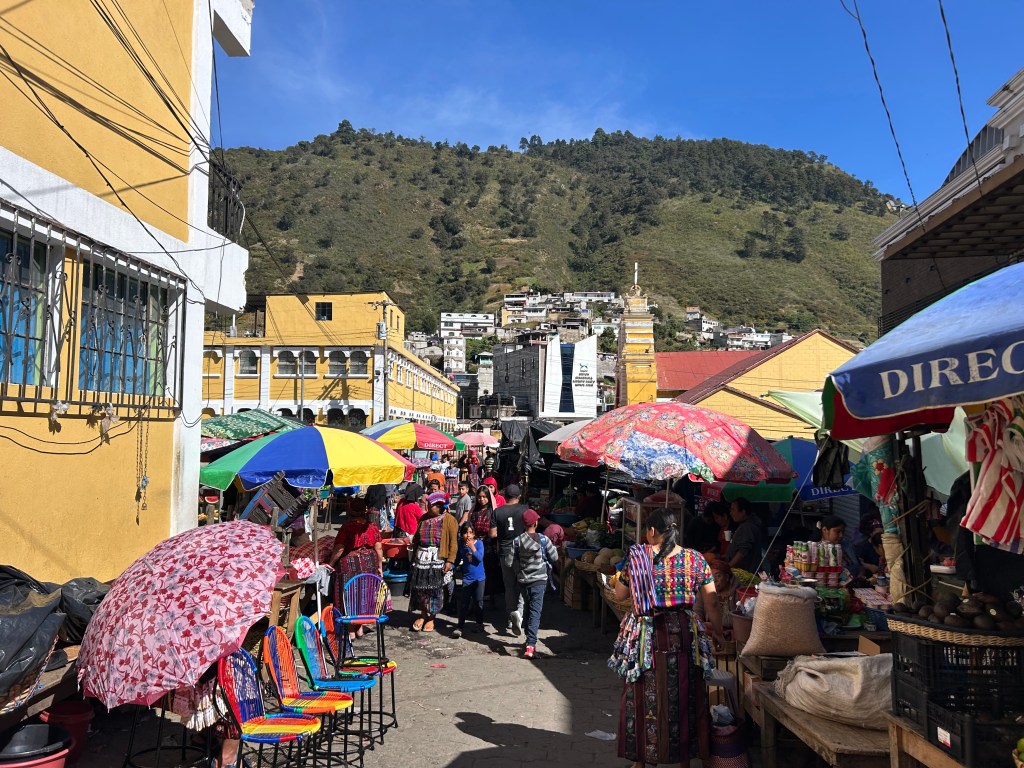
-The Almolonga market
I asked Don Lopez about the rising number of western style grocery stores in Zone 1, one of which being only a block away from Mercado de Flores. He told me it brings good, with more western style grocery stores in the area he concluded that the amount of refrigerators was also going up. He felt this was a beneficial change in regards to food safety, but in no way threatening to his business. He claimed people come to his stand because they know the food would be fresh, directly from local sources. He explained that he believes one would much rather eat a tomato picked only a few kilometers from their house, than a store bought one claiming the taste and nutrients are noticeably superior. I then proceeded to ask him about waste with the constant rotation of stock, to which he assured me there was almost none. Local animal farmers come to the market each day looking to buy over ripped produce to feed their animals, therefore lowering loss to almost zero, making his business incredibly stable and profitable.
The Lopez family buys in bulk at the markets at Almolonga, Zunil, and from Guatemala City – with all of the produce, apart from Haas Avocados (imported from neighboring Mexico), grown in Guatemala. With a majority of that produce being grown in the Zunil Valley under 10 km from our office at Quetzaltrekkers. This inspired me to take a trip to try and meet some of these farmers and thus track our produce all the way back to the farm.
My first stop was the Alamlonga market (on the outskirts of Xela) where the Lopez family buys the majority of their produce. A small market extending only the main square of the community. Just by looking at the produce I could tell the vast majority came from outside markets – things such as shrimp, limes, pineapples, nuts, and dried beans. Which then prompted me to catch a bus a few kilometers further, destined for the Zunil Valley. A beautiful East to West running valley, benefiting not only from intense sunshine but also a vast network of fresh water springs which drain into the valley, filling the roaring river that gives the community life. The locals make the most of this fertile valley, inhabiting the valley floor and have developed an intricate system of urban farming with houses separated by cuerdas (one cuerda measures 21 x 21 meters) of produce packed together edge to edge with green houses and cinder block homes dotting the valley floor and sprinkler irrigations spraying cool water mist over the carefully maintained dark earth.
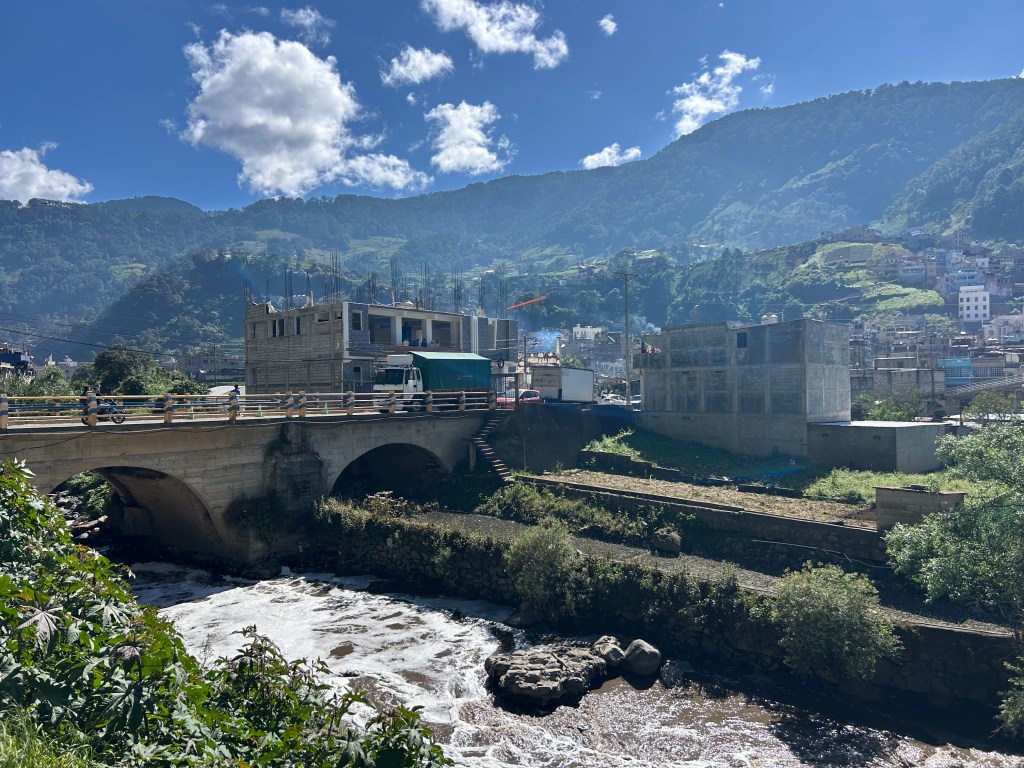
-The town on Zunil
There I had the privilege to meet and talk to farmer Juan Alex Machic, who gave me a great deal of insight into farming in Guatemala and could very well be one of the farmers whose produce we eat on our treks. A man in his mid 20s, Juan inherited his land from his parents and told me though there was a time when he tried to find another line of work, there was nothing he felt was as rewarding as farming. Together we talked about the unique, other times challenging, but highly rewarding feeling that comes with farming – working in harmony with nature and as a steward to the land. Juan has two plots of land, one on the valley floor measuring about 10 or 12 cuerdas and one of the many mountainside plots devoted solely to the production of maize measuring 6 cuerdas. He explained to me the fortunate position of the Zunil Valley, which due to the readily available mountain springs and intense sunshine, it’s possible to grow crops 12 months a year – with his fields often rotating between cauliflower, tomatoes, squash, carrots, cilantro, celery, and certain varieties of corn.
In some places irrigation is not possible, either due to either access to water or financial restrictions, and corn is instead farmed in the traditional highland schedule. In this system, planting begins at the first rainfall of the wet season in May and is harvested at the start of the dry season in late October or early November. Due to the lack of irritation on the volcanic slopes, Juan chooses to plant a particular variety of corn that produces on a 5 to 6 month basis in comparison to the corn on the valley floor that produces on a 3 to 4 month basis. However, he made sure to clarify that the corn grown at higher elevation, with the longer fruition time, was of a superior quality – and his metric of measuring so surprised me.
In the United States the vast majority of corn is not for human consumption. According to USDA Economic Research Service (ERS) 40 percent of all the corn in the United States is destined for animal feed and 45 percent destined for the production of ethanol, leaving only 5 percent of the market for human consumption (USDA ERS, n.d.). Juan however, noted that the most important factor in the quality of corn was based on the quality of tortillas or tamales it made. He explained that the variety he chose to plant at higher altitude created a dough which produced a more malleable tortilla when heated, was less sustainable to breakage, and of superior flavor. This, I believe, speaks to the values of Guatemalan society and culture of resourcefulness.
In speaking with Juan about his farming practices he mentioned making an active shift toward organic farming practices. He cited not only his concerns about harsh chemicals and their effects on soil heath, but also cited concerns for his own health/safety and that of his family. This is a change which can be seen all over Guatemala, especially in recent years with the Guatemalan government promoting sustainable farming practices and offering classes on organic farming methods for farmers (Gobierno de Guatemala, n.d.).
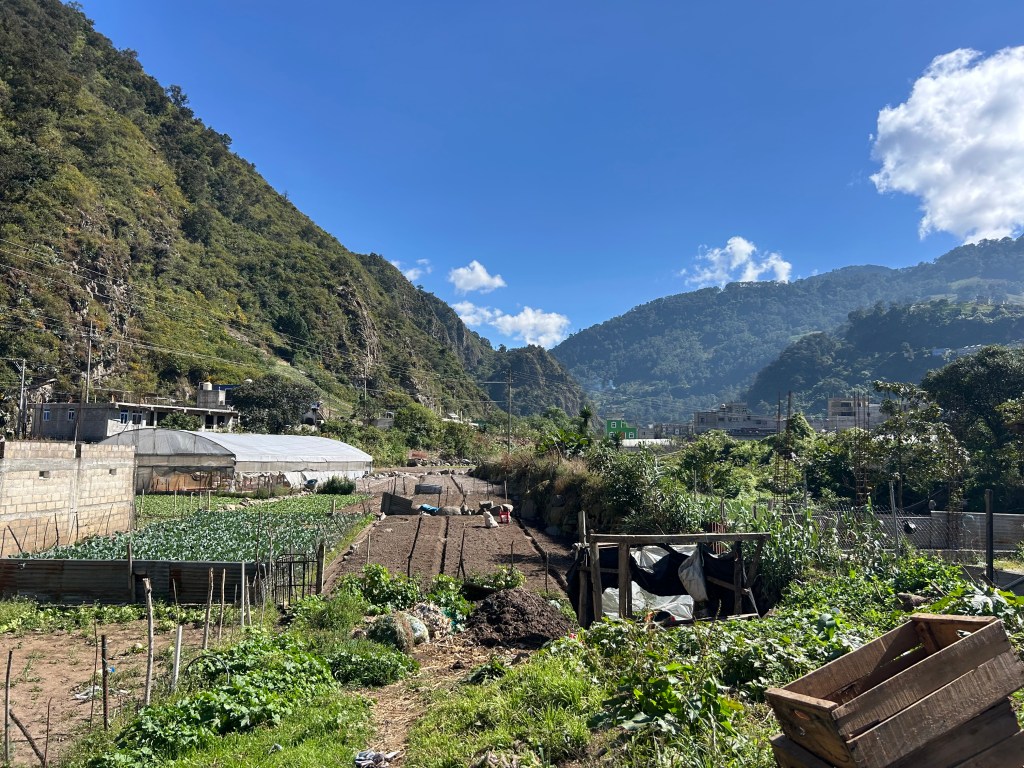
-The urban farming cuerda system of Zunil
From a business prospective, loss and market prices are constantly on Juan’s mind. Juan is privileged enough to have a contact who works at the Mercado International of Zunil where he sells his produce who gives him advice on future crop rotations and potential swings in the delicate produce market. For example, if there is an influx of tomatoes brought to market in a given time, the demand drops and so does the price as a result. But if demand is high for tomatoes and too few are brought to market, the farmer that brings tomatoes to market will receive higher compensation for his produce. The biggest danger in trying to predict the system is either miscalculating, bringing produce to market that is already in an excess, or a complete loss of crops, the majority of which Juan can attribute to fungal/bacterial growth in the rainy season – He has even lost whole cuadras of produce due to such events.
For the most part Juan works his fields alone apart from a few key moments in a growing season where he may employ up to three community members to aid with things such as weeding and harvesting. On harvest days crops are brought to the Mercado Internacional de Zunil early in the morning and are often sold to farm stands in Zunil/Alamonga where it then comes into contact with the Lopez family and subsequently into the iconic colorful tubs of Quetzaltrekkers’ hikes.
The other ingredients that round out the stands of Mercado de Flores are largely sold at the markets in Guate. These come from coastal low-land communities where food can be year round. In speaking with and interviewing lower income local indigenous community members, many go to the coasts during the highland dry season to work as agricultural laborers, helping to supplement their income while their fields back home sit barren.
Throughout this experience, though I have learned so much about high land agricultural practices, the most rewarding part has been developing connections with the community. For example: my relationship with Paula at the mercado de Flores, having grown so close with so much trust between us. Or my profound experience interviewing Don Antonio, a 78 year old farmer in the town of Xexocom, Quiche along our trek from Nebaj – Todos Santos. Someone who has never heard of the American state of California, and has been farming his steep hillside three times a day, every day, his whole life. He only ever leaves his community to go to market in Nebaj once or twice a week to bring his crops to market and supplement he and his family’s diet. It’s moments like these that put into perspective our position here in Guatemala as volunteers who come from largely industrialized, colonizing, western nation. We must listen, learn and empathize, not to ‘fix’ or ‘improve’ the nation or environment of those who call this place home. We are called to live and work here in harmony as respectful guests and neighbors with open hearts and minds.
Works Cited:
Ministerio de Energía y Minas de Guatemala. (2023). Política Nacional de Eficiencia Energética 2023–2050.
Retrieved from https://mem.gob.gt/wp-content/uploads/2023/11/Politica-Nacional-de-Eficiencia-Energetica-2023-2050.pdf
Instituto Nacional de Estadística de Guatemala. (2021). [Statistical Report].
Retrieved from https://www.ine.gob.gt/sistema/uploads/2021/04/27/20210427195413QDinUvuRa9GjopyXaTuNMXc3gd6Jq1Q1.pdf
Embajada de Guatemala. (n.d.). Organización político-administrativa: Departamento de Quetzaltenango.
Retrieved from https://www.embajadadeguatemala.org/pages/organizacion-politico-administrativa/departamento/quetzaltenango.php
FAO. (n.d.). Family farming: Guatemala.
Retrieved from https://www.fao.org/family-farming/countries/gtm/en/
Banco Interamericano de Desarrollo. (n.d.). Pueblos indígenas en Guatemala: desafíos demográficos, lingüísticos y socioeconómicos.
Retrieved from https://publications.iadb.org/es/pueblos-indigenas-en-guatemala-desafios-demograficos-linguisticos-y-socioeconomicos-analisis
Karlsson, Subamanian. Refrigerator ownership and child health and nutrition in low- and middle-income countries (2023). ScienceDirect.
Retrieved from https://www.sciencedirect.com/science/article/pii/S2211912423000287
U.S. Department of Agriculture, Economic Research Service. (n.d.). Feed grains sector at a glance.
Retrieved from https://www.ers.usda.gov/topics/crops/corn-and-other-feed-grains/feed-grains-sector-at-a-glance/
Gobierno de Guatemala. (n.d.). Las buenas prácticas agrícolas mejoran los cultivos.Retrieved from https://guatemala.gob.gt/las-buenas-practicas-agricolas-mejoran-los-cultivos/
 Quetzaltrekkers Guides